 Supplements
Best beef organ supplements for women: liver, heart, kidney for iron, B12, folate, and CoQ10. Evidence-based picks with quality standards and dosing guide.
Quick Answer: Best Picks
Best overall: Ancestral Supplements Grass-Fed Beef Liver — highest in absorbable iron, B12, and folate for energy and fertility support.
Best for cardiovascular: Heart & Soil Grass-Fed Beef Heart — rich in CoQ10, taurine, and selenium for women's heart and energy needs.
Best budget option: One Earth Health Grass-Fed Beef Organs Complex — blended formula covering liver, heart, and kidney at lower cost.
Best for hormones: Ancestral Supplements Grass-Fed Beef Organs — full-spectrum nose-to-tail nutrition with emphasis on reproductive support.
What Are Beef Organ Supplements?
Beef organ supplements are freeze-dried capsules or powders made from grass-fed cattle organs (liver, heart, kidney, pancreas). They represent "nose-to-tail" nutrition—the traditional practice of consuming whole animals, not just muscle meat. One capsule typically contains 2,000mg of freeze-dried organ tissue, equivalent to eating a 10-gram serving of fresh organ meat.
Unlike synthetic vitamins, organ supplements provide nutrients in their whole-food context. Beef liver, for example, contains not just iron, but iron-binding proteins, copper cofactors, and B-complex vitamins that enhance absorption and utilization. This bioavailable nutrient matrix is why organ supplements often outperform isolated synthetic supplements in user reports and emerging research.
Why Women Specifically Need Organ Nutrients
Women of reproductive age need 18mg iron daily, and 30% of menstruating women are iron-deficient. Beef liver provides highly absorbable heme iron (15-35% bioavailability vs 2-10% for plant iron). Organs are also rich in folate and B12 for fertility, CoQ10 for mitochondrial energy (which declines 50-75% between ages 20-80), and cholesterol precursors for estrogen and progesterone synthesis.
Key Organs & Their Nutrients
Beef Liver
The most nutrient-dense organ: 5-7mg heme iron, 5-15mcg B12, 220-240mcg folate, and 5,000+ IU vitamin A per serving. Addresses the most common women's deficiencies. A 2020 Nutrients study found women showed significant energy and mood improvements within 8 weeks of supplementing beef liver extract.
Beef Heart
Exceptionally high in CoQ10 (10-100mg per serving), taurine (1-2g), and carnitine (200-400mg). Supports mitochondrial energy, cardiovascular function, and bone mineral density -- particularly important for women over 40 and postmenopausal osteoporosis prevention.
Beef Kidney
Rich in selenium (150-200mcg, 300% daily value), zinc (8-12mg), and B vitamins. Critical for thyroid function, immune health, skin, and fertility. Particularly valuable during high-stress periods.
Quality Markers to Look For
Prioritize grass-fed sources (2-3x more omega-3 than grain-fed), freeze-dried processing (heat can destroy 50-80% of B vitamins), third-party testing (NSF, USP, or ConsumerLab certifications), and transparent sourcing specifying the farm or region. New Zealand and Australian beef typically has lower antibiotic exposure due to stricter regulations.
Top Product Recommendations

Ancestral Supplements Grass-Fed Beef Liver
Ancestral Supplements- 10,000+ IU vitamin A per serving
- 5-7mg heme iron (highly absorbable)
- 60mcg B12, 240mcg folate
- Third-party tested for purity
- 100% grass-fed New Zealand cattle
- No fillers, binders, or flow agents
Why we recommend it: Ancestral Supplements Beef Liver is the gold standard for women seeking iron, B12, and folate. Each 3-capsule serving provides comprehensive micronutrient support for energy, fertility, and mood. The company sources directly from grass-fed New Zealand cattle and conducts third-party heavy metals testing. Women report noticeable energy improvements within 2-3 weeks.
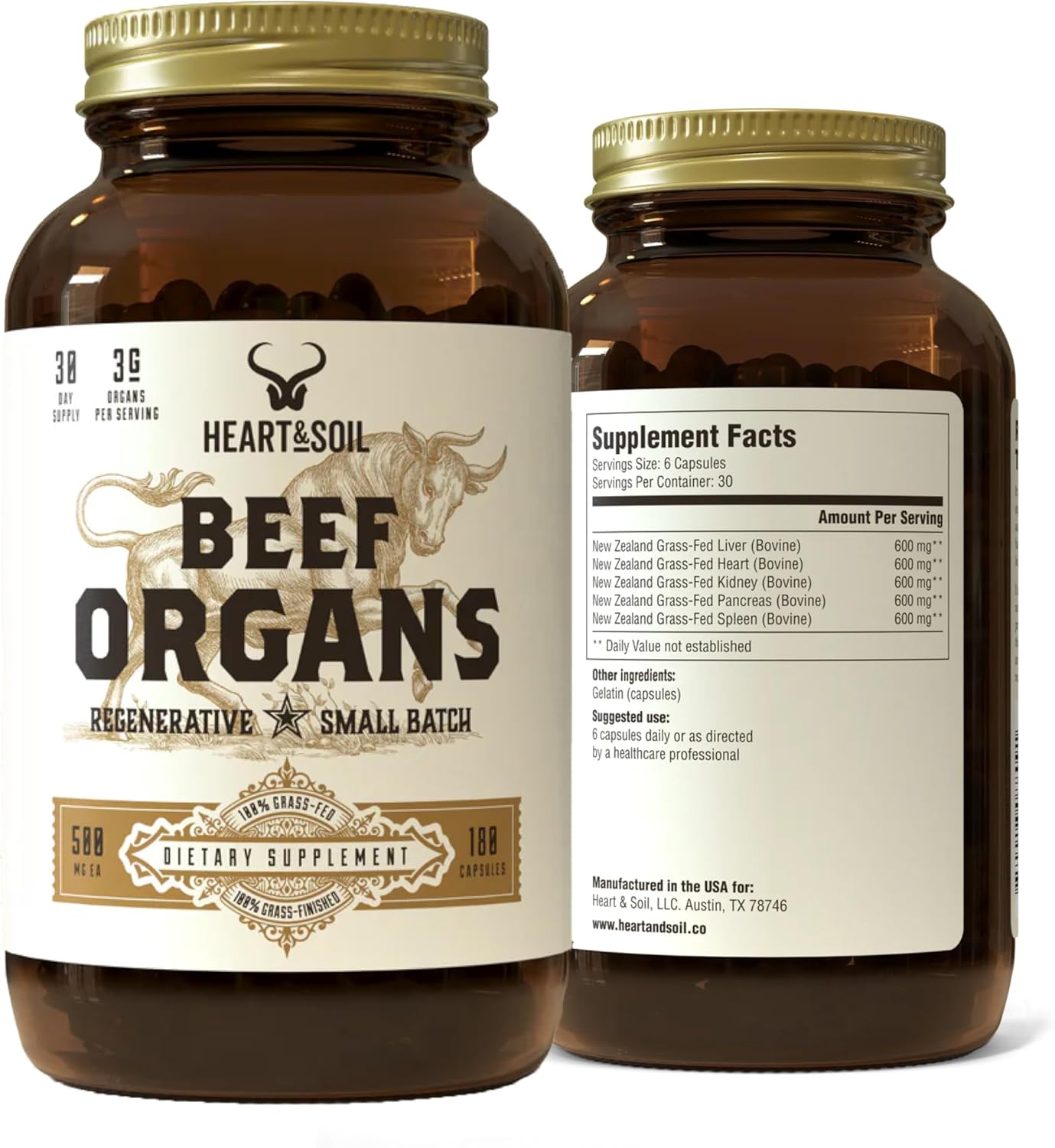
Heart & Soil Grass-Fed Beef Heart
Heart & Soil- 10-50mg CoQ10 per serving
- 1-2g taurine for cardiovascular support
- Rich in carnitine and B vitamins
- Ultraviolet-light irradiated for safety
- 100% grass-fed pasture-raised
- Supports mitochondrial energy production
Why we recommend it: Heart & Soil Beef Heart is the premium choice for women over 40 or those experiencing fatigue. The CoQ10 and taurine content directly addresses age-related energy decline and cardiovascular health. Taurine is particularly valuable for women, as it concentrates in the heart, brain, and retina. The product uses grass-fed Australian and North American sources.

One Earth Health Grass-Fed Beef Organs
One Earth Health- Blend of liver, heart, kidney, pancreas, spleen
- Complete nose-to-tail nutrition profile
- 3,000mg per serving (3 capsules)
- 65mg per serving total organ powder
- Grass-fed and pasture-raised
- Budget-friendly option without quality compromise
Why we recommend it: One Earth Health offers the best value. By blending multiple organs, it provides balanced nutrition: iron from liver, CoQ10 and taurine from heart, selenium and zinc from kidney. This approach mirrors traditional nose-to-tail eating. It's 30-40% cheaper than single-organ supplements while providing broader micronutrient coverage. Ideal for women new to organ supplements.
Dosing & Safety
Take 2-3 capsules daily with meals (start with 1-2 the first week). If you're postmenopausal, have hemochromatosis risk, or already take iron supplements, get an iron panel before starting liver supplements. Separate from thyroid medication by 4+ hours. During pregnancy, limit to 1-2 capsules daily to keep vitamin A under 10,000 IU, and consult your OB.
Our Verdict
Start with Ancestral Supplements Beef Liver for iron, B12, and energy support. Add Heart & Soil Beef Heart if you're over 40 or experiencing fatigue beyond iron deficiency. For budget-friendly nose-to-tail coverage, One Earth Health's blend covers liver, heart, and kidney in one product. Always prioritize grass-fed, freeze-dried, third-party tested products -- the premium is justified by superior bioavailability.
Quick Comparison
| Product | Key Feature | Best For |
|---|---|---|
| Ancestral Supplements | 10,000+ IU vitamin A per serving | Top Pick |
| Heart & Soil Grass-Fed Beef Heart | 10-50mg CoQ10 per serving | |
| One Earth Health | Blend of liver, heart, kidney, pancreas, spleen |
Bottom Line: Which Should You Buy?
For most people: the Ancestral Supplements Grass-Fed Beef Liver. 10,000+ IU vitamin A per serving.
On a budget: the Heart & Soil Grass-Fed Beef Heart. 10-50mg CoQ10 per serving.
Premium pick: the One Earth Health Grass-Fed Beef Organs. Blend of liver, heart, kidney, pancreas, spleen.
Ready to buy?
Jump straight to our top picks on Amazon.
Frequently Asked Questions
Are beef organ supplements safe for women?
Yes, when sourced from grass-fed cattle and third-party tested. Beef organ supplements are whole-food nutritional supplements, not medications. Women of reproductive age should monitor iron intake if taking high-dose liver supplements, as iron from heme sources is highly bioavailable. Generally 1-2 capsules daily is safe for most women.
Why do women need beef organ supplements?
Women have higher iron requirements than men, especially those menstruating (18mg daily vs 8mg for men). Beef organs are rich in heme iron (highly absorbable), B12 for energy and neurological function, folate for fertility, and CoQ10 for cellular energy and cardiovascular health. These nutrients are particularly important during reproductive years and menopause.
What's the difference between beef liver, heart, and kidney supplements?
Beef liver is highest in iron, B12, folate, and vitamin A. Heart provides CoQ10, taurine, and selenium for cardiovascular support. Kidney offers zinc, selenium, and B vitamins. Many women benefit from a blend, or rotating between single-organ supplements. Start with liver for iron and energy support.
How much beef organ supplement should women take?
Standard dosing is 1-3 capsules daily with meals, depending on the product's concentration and your goals. High-quality supplements like Ancestral Supplements typically recommend 3 capsules daily (equivalent to 2,000mg of freeze-dried organ powder). Follow the label and consult a healthcare provider if you're on iron supplements or have hemochromatosis.
Related Articles


Sources & Research
This article was informed by peer-reviewed research and clinical guidelines. The Supplements Corner Editorial Team reviews published literature to ensure accuracy.
Dosage Reference
Key nutrients for women per NIH: iron 18 mg/day (premenopausal), calcium 1,000–1,200 mg/day, vitamin D 600–800 IU/day, folate 400 mcg/day, magnesium 310–320 mg/day.
Key Studies Referenced:
- Bailey RL, Dodd KW, Goldman JA, et al. (2010). "Estimation of total usual calcium and vitamin D intakes in the United States." Journal of Nutrition, 140(4), 817–822.
- Holick MF. (2007). "Vitamin D deficiency." New England Journal of Medicine, 357(3), 266–281.
- Low MSY, Speedy J, Styles CE, et al. (2016). "Daily iron supplementation for improving anaemia, iron status and health in menstruating women." Cochrane Database of Systematic Reviews, (4), CD009747.
Medical Disclaimer: This content is for informational purposes only and does not constitute medical advice, diagnosis, or treatment. Always consult a qualified healthcare provider before starting, stopping, or changing any supplement regimen. Individual results may vary.